Which of These Three Seed Starting Kits Is Best? (2026 Comparison)
Short answer: Here is how to start seeds indoors: sow them in moist seed-starting mix 2 to 10 weeks before your last frost (depending on the crop), keep the mix at 65 to 75°F under a clear dome until sprouts appear, then move them under lights 14 to 16 hours a day and water from below. Of the three kits we compared, the VIVOSUN 6-pack trays with a heat mat is the best all-round choice, because it is the only one that supplies the bottom heat extension services recommend. Pick the Jiffy peat-pellet greenhouse for the easiest start, or the Burpee self-watering kit if you tend to forget watering.
Ratings, prices and buyer comments were read from Amazon on November 25, 2026. Prices change often.
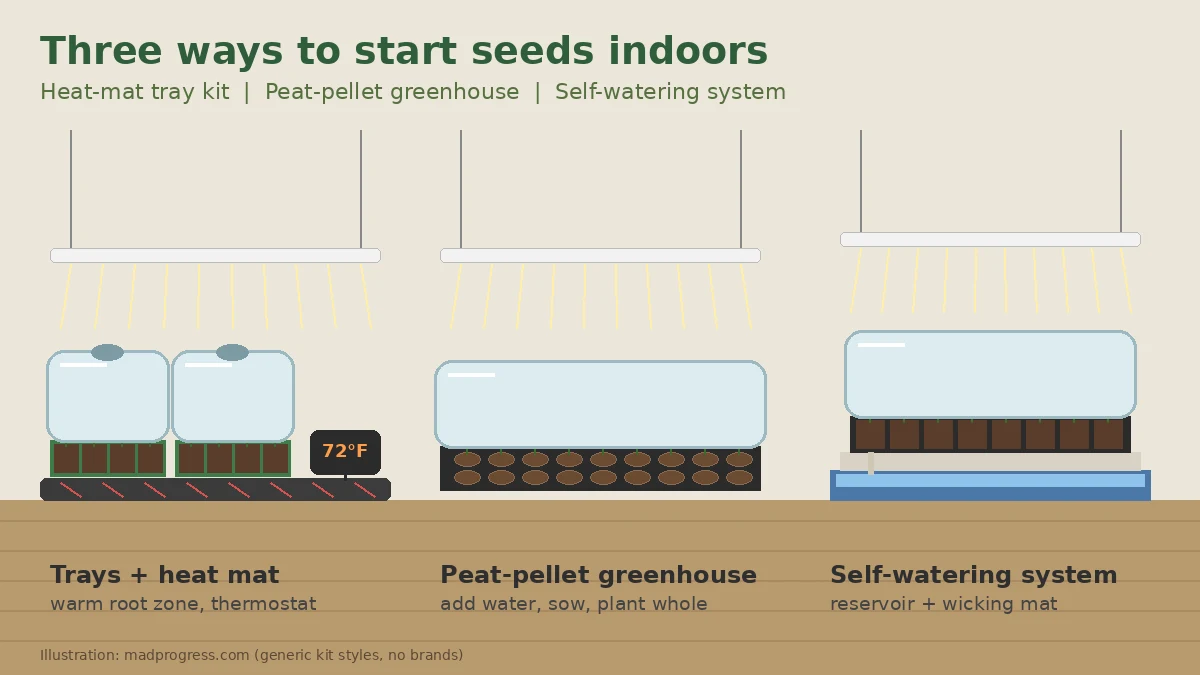
Which seed starting kits did we compare?
We picked one well-rated kit of each common style: a tray set with a heat mat, a peat-pellet greenhouse and a self-watering system, and checked them against extension-service advice. None includes a light; we compared those separately in our guide to the best grow lights for seedlings and how high to hang them.
Disclosure: This post contains affiliate links. If you buy through them, Mad Progress may earn a commission at no extra cost to you. As an Amazon Associate, Mad Progress earns from qualifying purchases.
1. VIVOSUN 6-Pack Seed Starter Trays with Heat Mat (best overall)
Amazon rating: 4.4 out of 5 stars from 337 ratings (checked Nov 25, 2026).
The VIVOSUN kit pairs six 12-cell trays (72 cells in all), each with a clear dome and an adjustable vent, with a 10 x 20.75-inch waterproof heat mat. The mat plugs into a digital thermostat controller that lets you set a target temperature and shows the reading. You supply the mix.
Amazon’s AI-generated review summary says buyers find the trays great for getting seeds started and worth the money, but heating performance gets mixed feedback: 24 positive and 17 negative mentions. One buyer wrote, “Started my tomatoes in these and did I have great results!” Another said the heating pad “turns on but shuts off in less than a minute.”
- Pros: Only kit here with bottom heat and a thermostat; vented domes; reusable trays; waterproof mat.
- Cons: Fewest ratings; some buyers report faulty heat mats or seedlings hard to remove; no mix included.
2. Jiffy Seed Starting Greenhouse with Peat Pellets, 2-Pack (easiest start)
Amazon rating: 4.5 out of 5 stars from 1,135 ratings (checked Nov 25, 2026).
The Jiffy greenhouse is two 11 x 21-inch trays with clear domes and compressed 36mm peat pellets. You add water, the pellets swell, and you drop seeds in. Each pellet goes into a bigger pot or the garden whole, which limits root disturbance. The listing is inconsistent on the pellet count: the title says 144 in total, while a bullet says 72.
Amazon’s summary says buyers find it works well and is easy to use, with good germination, but the trays get negative feedback for sturdiness (2 positive and 8 negative mentions). One buyer reported, “Out of 75 seeds planted, I have 75 seedlings.” Another said the trays “are a little flimsy but work well for starting seeds.” A third advised, “don’t keep the plastic cover on very long.”
- Pros: Highest rating; no potting mix needed; pellets transplant whole.
- Cons: No heat; flimsy trays; refill pellets cost extra.
3. Burpee 72-Cell Self-Watering Seed Starter Kit (best for forgetful waterers)
Amazon rating: 4.3 out of 5 stars from 3,476 ratings (checked Nov 25, 2026).
The Burpee kit has two 36-cell trays (cells 1.5 x 1.5 x 2 inches) sitting on stands over a water reservoir. A capillary mat wicks water up into the cells. It also includes 72 coco coir pellets, a dome, plant markers and planting diagrams. It is sold by Amazon, and Burpee’s listing recommends adding a heat mat for germination.
Amazon’s summary says the kit works well for getting seeds started, but 117 of 142 durability mentions are negative, with buyers calling it flimsy, and many say the dome does not fit well. One buyer wrote, “The self watering mat is very helpful in retaining moisture.” Another wrote, “the ‘self watering’ doesn’t really self water.” A third reported, “Half of the tray stays dry and all seeds died.”
- Pros: Lowest price; reservoir evens out watering; medium included; most ratings.
- Cons: Many complaints about thin plastic and a loose dome; some buyers say wicking is uneven; no heat.
How do the three seed starting kits compare?
| Feature | VIVOSUN Trays + Heat Mat | Jiffy Greenhouse 2-Pack | Burpee Self-Watering |
|---|---|---|---|
| Amazon rating (Nov 25, 2026) | 4.4 / 5 (337) | 4.5 / 5 (1,135) | 4.3 / 5 (3,476) |
| Price seen on Amazon | $30.59 | $26.99 | $19.97 |
| Cells or pellets | 72 cells (6 x 12) | Peat pellets (72 or 144; listing conflicts) | 72 cells (2 x 36) |
| Heat mat | Yes, with thermostat | No | No |
| Growing medium included | No | Peat pellets | Coco coir pellets |
| Watering | By hand; drain holes | By hand into tray | Reservoir and wicking mat |
| Best for | Peppers, tomatoes, cool rooms | First-timers, quick crops | Busy or forgetful gardeners |
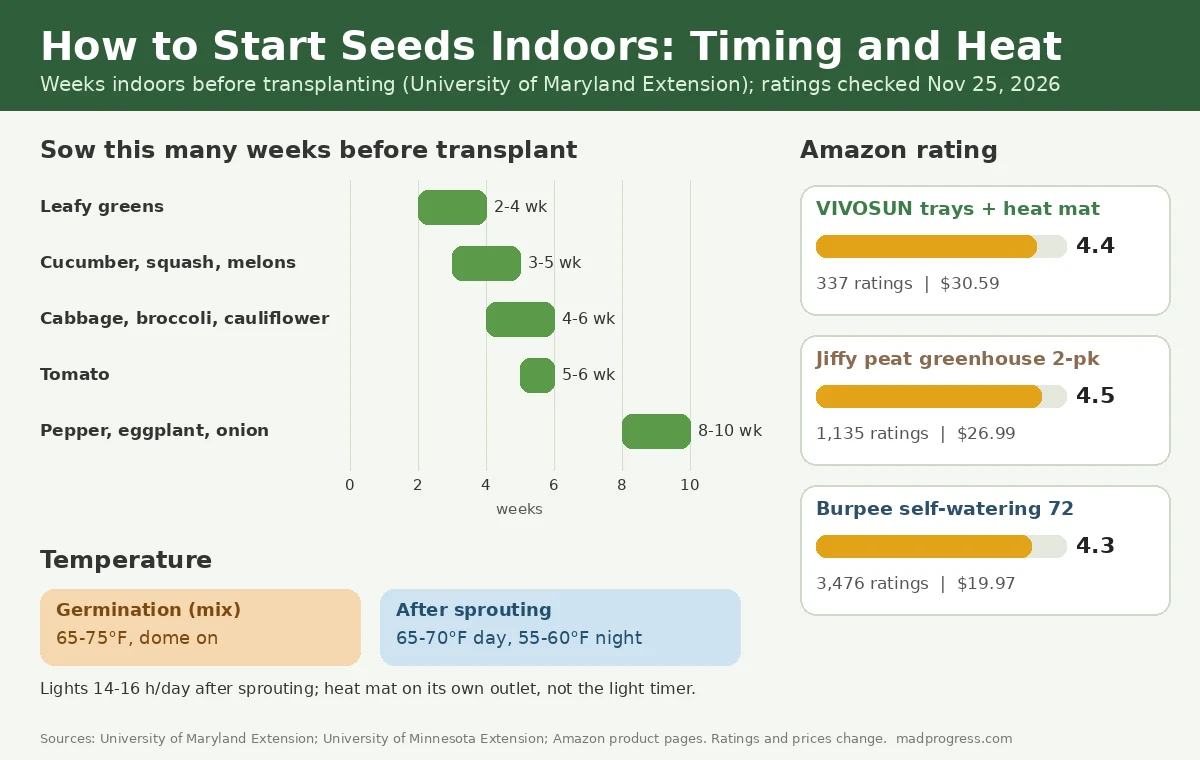
How do you start seeds indoors? A simple schedule
This schedule follows the Maryland, Minnesota and Iowa State extension guides and works with any of the three kits.
- Count back from your last frost date. Maryland Extension gives these indoor times: leafy greens 2 to 4 weeks, cabbage family 4 to 6, cucumbers and squash 3 to 5, tomatoes 5 to 6, and peppers, eggplant and onions 8 to 10.
- Moisten the mix first. Work warm water into soilless mix until it feels like a wrung-out sponge, then fill the cells. With pellet kits, just soak the pellets.
- Sow at the right depth. Minnesota Extension’s rule of thumb is twice as deep as the seed is wide. Seeds that need light stay on the surface. Label everything.
- Cover and warm. Put the dome on and keep the mix at 65 to 75°F. A heat mat helps here.
- Check daily and lift the dome at the first sprouts. Iowa State says ventilation discourages damping off, a disease that attacks young stems at the soil line.
- Light right away. Give seedlings 14 to 16 hours a day with the light a few inches above the leaves. Our seedling grow light comparison covers the exact heights.
- Cool them down. After germination, Maryland suggests 65 to 70°F days and 55 to 60°F nights, so turn off the heat mat or lower its setting.
- Water when the top is nearly dry. Bottom-water by filling the tray and pouring off what is not absorbed.
- Feed lightly. Once seedlings have several true leaves, Minnesota recommends a quarter-strength water-soluble fertilizer once a week.
- Pot up and harden off. Move crowded seedlings to bigger pots after the first true leaves. Harden them off outdoors over two weeks, then transplant on a cloudy day or in late afternoon.
Do you need a heat mat to start seeds?
Not always, but it helps. Minnesota Extension says most seeds started indoors germinate sooner and grow healthier roots in warm mix, and bottom heat can help prevent damping off. Wisconsin Extension adds that once seedlings are up, most grow better cooler, so turn the heat down. Minnesota also warns not to plug the heat mat into the light timer.
What do you need before you sow? A checklist
- ☐ Seeds, and the frost date for your area
- ☐ Clean trays or cells with drainage, plus a solid tray underneath
- ☐ Fresh soilless seed-starting mix or pellets (not garden soil)
- ☐ A clear humidity dome
- ☐ A heat mat, ideally with a thermostat, plugged into its own outlet
- ☐ A grow light you can raise as plants grow, plus an outlet timer
- ☐ Labels and a marker
- ☐ A small fan for air movement after sprouting
Reusing old trays? Iowa State recommends washing them, then disinfecting in one part bleach to nine parts water. An old shop fixture still works for light; our post on setting up fluorescent lights for seed starting explains why timers and soil temperature matter.
Which seed starting kit is best?
Verdict: The VIVOSUN trays with heat mat is the best of the three for most home gardeners. It is the only kit that supplies the warm root zone extension services recommend, with a thermostat and vented domes. Test the mat as soon as it arrives.
- Choose the VIVOSUN kit if you start peppers, tomatoes or eggplant in a cool room.
- Choose the Jiffy greenhouse if it is your first year and you want the simplest setup.
- Choose the Burpee self-watering kit if you are often away and want the lowest price, and you accept thinner plastic.
When your hardened-off seedlings are ready, they do well in a metal raised garden bed filled with fresh soil, and thinned seedlings and spent mix can go into a backyard compost bin. Browse more of our home and garden buying guides.
Frequently asked questions
When should I start seeds indoors?
Count back from your last frost date. University of Maryland Extension suggests 2 to 4 weeks for leafy greens, 5 to 6 weeks for tomatoes and 8 to 10 weeks for peppers, eggplant and onions. Starting too early gives leggy plants.
Do you need a heat mat to start seeds?
Not always, but it helps warm-season crops. Minnesota Extension says warm potting mix speeds germination, grows healthier roots and can help prevent damping off. Aim for 65 to 75°F in the mix, and keep the mat off your light timer.
How often should you water seedlings?
Water when the top of the mix is nearly dry, not on a fixed schedule. Keep it moist but never soggy. Bottom watering through the tray works well; pour off water the mix does not absorb.
When should seedlings be transplanted?
Pot seedlings up into bigger containers soon after their first true leaves appear. Move them outdoors after about two weeks of hardening off, once frost danger has passed, on a cloudy day or late afternoon.
Can you start seeds indoors without grow lights?
You can, but results are weaker. Minnesota Extension says windowsills swing between cold and hot and seedlings there tend to stretch. Grow lights 14 to 16 hours a day, a few inches above the leaves, give stockier plants.
Sources
- Amazon product page, VIVOSUN 6-Pack Seed Starter Trays & 10″x20.75″ Seedling Heat Mat (checked Nov 25, 2026): https://www.amazon.com/dp/B0BHW1FXK2
- Amazon product page, Jiffy Ferry Morse Seed Starting Greenhouse Tray Kit, 2 Pack (checked Nov 25, 2026): https://www.amazon.com/dp/B07X4KGX1L
- Amazon product page, Burpee 72-Cell Self-Watering Seed Starter Kit (checked Nov 25, 2026): https://www.amazon.com/dp/B00SNLOTUK
- University of Maryland Extension, “Starting Vegetable Seeds Indoors” (updated Aug 14, 2026): extension.umd.edu
- University of Minnesota Extension, “Starting seeds indoors” (reviewed 2026): extension.umn.edu
- Iowa State University Extension, “How to Successfully Start Seed Indoors” (last reviewed December 2023): yardandgarden.extension.iastate.edu